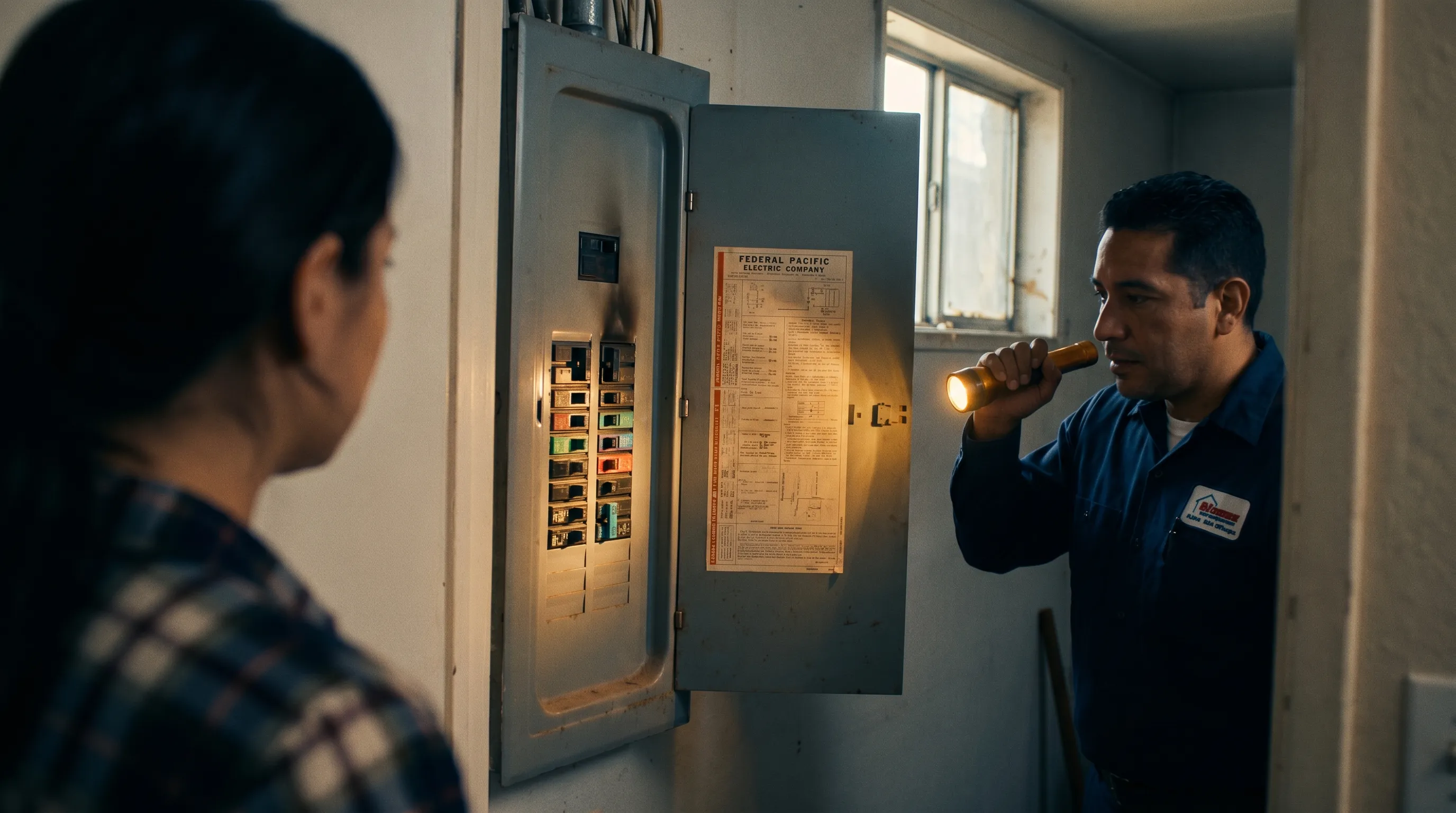
If your El Cajon home was built anywhere between the 1950s and the late 1980s, your electrical panel might be a Federal Pacific Electric Stab-Lok, the single most documented fire hazard sitting in American homes today.
This is especially common in Bostonia, Fletcher Hills, Granite Hills, and parts of west Santee. We see at least one Stab-Lok panel in El Cajon every week. Many homeowners don’t know they have one, and many that do think it’s fine because it’s been working for 40 years.
It hasn’t been working. It’s been failing slowly.
What is the Stab-Lok and why is it still in homes?
Federal Pacific Electric (FPE) was a major electrical equipment manufacturer from the 1950s through the early 1980s. Their Stab-Lok line of breaker panels, recognizable by the red toggle strip on every breaker, was installed in millions of American homes during the post-war housing boom.
Two engineers (Aronstein and Newman) independently tested Stab-Lok breakers in the late 1970s and early 1980s. They found that under simulated overload and short-circuit conditions:
- Up to 25% of single-pole Stab-Lok breakers failed to trip
- Up to 65% of two-pole Stab-Lok breakers failed to trip (these protect 240V circuits like AC, electric range, dryer)
- Many breakers physically jammed in the panel and could not be removed for testing without damaging them
- Some breakers tested showed visible arcing damage from previous undocumented faults
The Consumer Product Safety Commission opened a formal investigation in 1980. They documented the failure rates but the investigation was halted in 1983, not because the panels were cleared, but because Federal Pacific Electric was sold and went out of business. There was never a federal recall, no mandatory replacement program, no consumer notification.
The panels stayed in homes. They’re still there.
Why FPE Stab-Lok breakers fail
The failure mode is mechanical and metallurgical. The internal trip mechanism uses a thin bimetallic strip and a calibration spring. Under design conditions (1960s manufacturing tolerances, fresh installation), they trip correctly most of the time. Over decades of:
- Thermal cycling (warming and cooling under daily load)
- Mild over-current events (a vacuum starting, a tool drawing high startup current) that don’t trigger a trip but stress the mechanism
- Oxidation at the bus-bar contact and the trip mechanism
- Calibration drift in the spring tension
…the breakers progressively lose the ability to trip when they should. Worse, they often appear to function normally (the toggle still moves, the lights still work), but under an actual fault (a short circuit, a sustained overload), they hold instead of trip.
That’s when fires happen.
How to identify a Stab-Lok in your home
Three visual cues, in order of reliability:
1. The breakers themselves. Stab-Lok breakers have a distinctive red strip across the toggle handle. Most other breaker brands (Square D, Eaton, Siemens) have black or solid-color toggles. The red is unique to Stab-Lok.
2. The panel cover branding. The dead-front cover (the metal panel with the breaker openings) often says “FEDERAL PACIFIC” or “FPE” or “STAB-LOK” along the top edge or in the manufacturer label.
3. Vintage. If your home was built between 1955 and 1985 and the panel hasn’t been replaced, FPE Stab-Lok is one of the more likely brands. Other panels from that era (Pushmatic, Zinsco) are also problematic but visually different.
If you have a Stab-Lok and your home is more than 30 years old, you’re almost certainly also dealing with aluminum branch wiring or other vintage-era issues. Not a coincidence. The homes were built in the same era under the same code regime.
If you’re unsure, send us a photo of the open panel and we’ll identify it for free, no quote required.
Why insurance carriers are now requiring replacement
We’ve seen accelerating action from California insurance carriers in the last 18 months. Specifically:
- State Farm: has issued non-renewal notices in El Cajon and Santee tied to FPE Stab-Lok panels (we’ve seen 3 of these directly in the last year)
- Allstate: flags Stab-Lok during property inspections; may require replacement before policy bind
- Mercury: similar; particularly aggressive in 1960s-1970s housing tracts
- AAA / Auto Club: has historically been more lenient but is tightening
If you’re shopping insurance, expect the question. If you’re at renewal and your panel is a Stab-Lok, expect the conversation.
What replacement looks like
Replacing a Stab-Lok panel with a modern Square D Homeline or Eaton BR panel is a standard service. Cost ranges in El Cajon:
- Direct replacement (same amperage, same location, no surprises): $2,000 to $3,000
- Replacement + amperage upgrade (100A → 200A, common): $2,500 to $4,000
- Replacement + meter relocation + ADU sub-panel: $3,500 to $5,500
We covered the line-item detail in our panel upgrade cost breakdown. The Stab-Lok replacement specifically isn’t more expensive than a generic panel upgrade, but discovering one is the most common urgency-driver among our jobs.
You can also see the broader symptom set in our 5 signs you need a panel upgrade. A Stab-Lok diagnosis is one of those signs by itself.
Why we treat this as a Local-tagged story
We tag this post under “Local” rather than just “Tips & Safety” because El Cajon’s housing stock is disproportionately affected. The Bostonia tract development of the 1960s and the Fletcher Hills expansion of the 1970s used FPE panels heavily. Granite Hills (1960s-80s) too. Same with parts of Santee around Carlton Hills and old west Spring Valley.
If you live in one of these neighborhoods and the home is older than 1985, the question isn’t “could I have a Stab-Lok.” It’s “does mine still need replacement, or did a previous owner already handle it.” The panel cover tells you.
Why Martinez Electric for Stab-Lok replacement
In 35+ years at the trade, owner Vicente Martinez has replaced more FPE Stab-Lok panels than he can count, many right here in El Cajon. We carry the most common replacement equipment on the truck (Square D Homeline 30 and 40-space loadcenters, common breaker sizes, surge protectors), so we can scope and quote the same day. CSLB licensed (#1052901), every job permitted with the City of El Cajon.
If you suspect a Stab-Lok, the urgency depends on its current condition. A quiet, no-symptom Stab-Lok can wait 6 to 12 months for a planned replacement. A Stab-Lok with breakers that won’t reset, a warm panel cover, or any burning smell is an emergency.
Send us a photo: Free identification or call (619) 249-0956. If it’s a Stab-Lok, we’ll quote the replacement at the same time. If it’s not, we’ll tell you that for free and you can stop worrying about it.