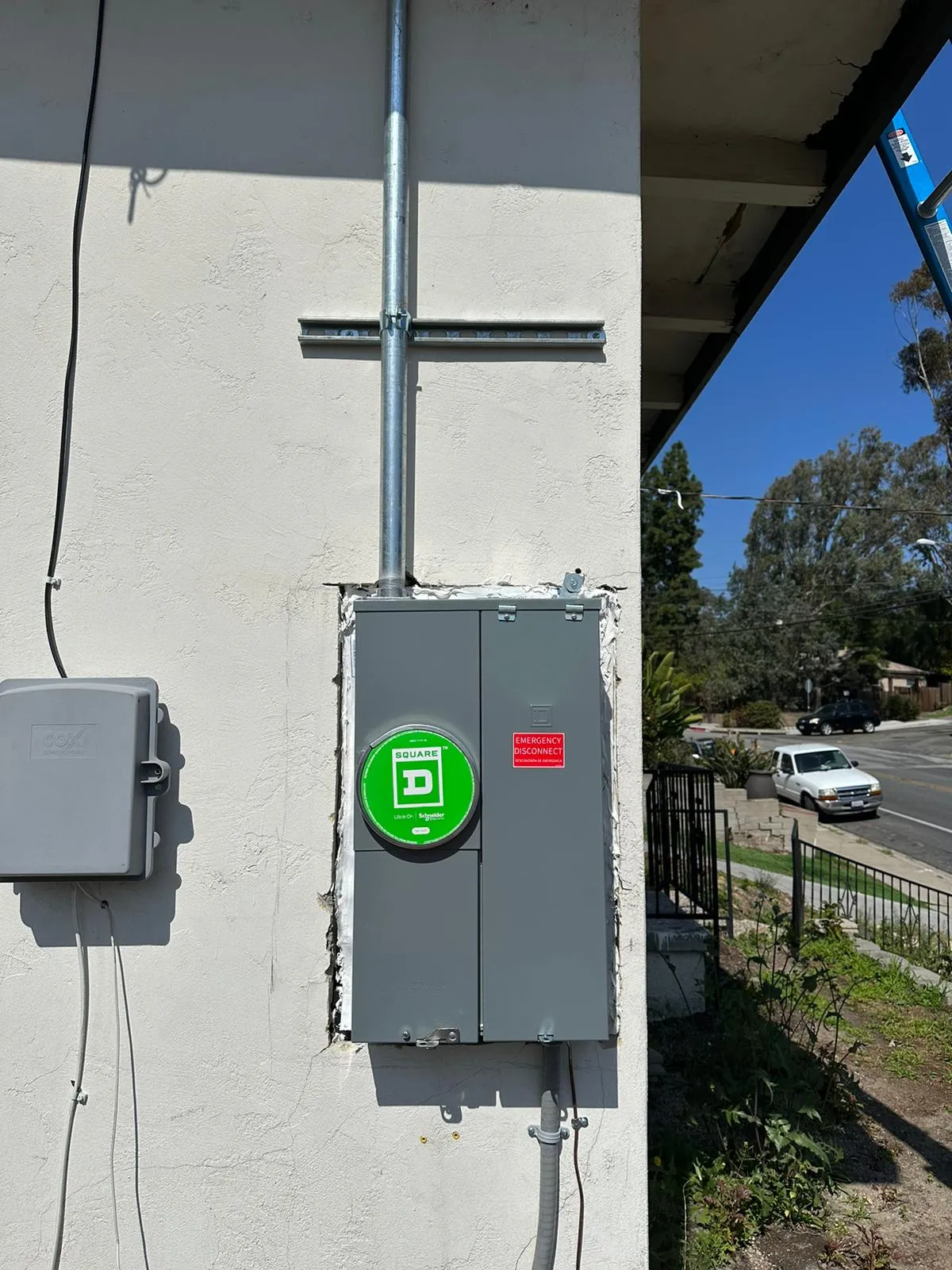
If you just bought an EV in San Diego County, the install cost matters as much as the charger itself. The Tesla Wall Connector or Level 2 charger in the box is the cheap part. What runs from your panel to your garage is where the real cost lives.
Here’s the 2026 breakdown for El Cajon, La Mesa, San Diego, and Poway.
What does a Level 2 EV charger cost to install?
| Scenario | Typical cost | What’s included |
|---|---|---|
| Best case: modern 200-amp panel, garage on same wall | $800 to $1,200 | Charger mount, 30 ft of conduit, dedicated 50-amp breaker, permit, inspection |
| Typical: a 150 or 200-amp panel, conduit run across one wall | $1,400 to $2,200 | Same as above + 50 to 80 ft conduit, drywall patch, junction box |
| Panel upgrade required: 100-amp panel can’t support charger | $2,800 to $4,500 | Everything above + 200-amp panel upgrade ($2,000 to $4,000, see our panel cost breakdown) |
| Detached garage / long run: 50+ ft from house, trenching | $2,200 to $3,500 | Trenching, weatherproof conduit, sub-panel if needed |
The $800 to $3,500 range you see online is real, but the spread is almost entirely about your panel and conduit run, not the charger.
What actually drives the cost up
1. Your panel’s current capacity
A Level 2 charger pulls 32 to 48 amps continuously. The National Electrical Code requires continuous loads use only 80% of a circuit’s capacity, so a 48-amp charger needs a 60-amp circuit. If your 100-amp panel already runs AC + electric range + dryer, there’s no headroom, so you’ll need a 200-amp upgrade before the charger goes in.
If you’re not sure what amperage your panel is, look at the main breaker number at the top of your service panel. We also wrote a guide to the 5 signs you need a panel upgrade that covers this.
2. Distance from panel to charger
Every additional 10 feet of conduit adds wire cost (10-gauge or 6-gauge depending on charger amperage), labor for routing, and sometimes drywall repair. A garage on the same wall as your panel is the cheapest case. A garage on the opposite end of the house with a 70-foot run is materially more expensive.
3. Charger type and amperage
A 32-amp charger is fine for most overnight charging. It adds about 25 miles of range per hour. A 48-amp charger is faster (about 37 miles per hour) but needs heavier 6-gauge wire and a 60-amp breaker. The hardware difference is small ($150 to $300) but the wire upgrade adds another $100 to $200.
4. Permit and inspection
San Diego County cities all require an electrical permit for EV charger installs. Permit fees range from $75 (El Cajon) to $200 (some San Diego neighborhoods). We pull every permit and schedule the inspection. It’s included in our quote, never a surprise add-on. See our electrical permits guide for the full city-by-city breakdown.
Tax credits and SDG&E rebates that bring the cost down
Federal tax credit (through 2032): The Alternative Fuel Vehicle Refueling Property Credit covers 30% of installation costs up to $1,000 for residential installs in eligible census tracts. Most of San Diego County qualifies. Claim it on your tax return, and keep your invoice.
SDG&E EV charger rebates: SDG&E runs intermittent rebate programs (the Power Your Drive program is the current one as of April 2026, offering up to $400 for residential chargers in certain low-income areas). The terms change yearly, so we’ll check the current offer when we quote.
California Clean Fuel Reward: Separate from charger rebates. It applies when you bought the EV. Worth checking if you haven’t already.
Stack all three and the net cost in 2026 typically lands $400 to $1,000 below sticker.
Why your panel matters first
We’ve had homeowners order a $700 charger online, only to find out their 100-amp panel won’t support it. They end up paying for a panel upgrade and the charger install at once, usually around $4,000 total, when they thought it would be $1,200.
If you’re EV-curious but haven’t bought yet, get a load calculation done first. We do them as part of any free estimate. It takes 20 minutes and tells you exactly what you’ll need before you commit to a charger model. The same applies if you’re getting an electrician for the first time, ask about the load calc.
Permit and inspection: what to expect
Every EV charger install in San Diego County requires a city electrical permit. We file it under our CSLB license (#1052901), schedule the inspection, and meet the inspector ourselves. You don’t have to be home for the inspection unless the inspector needs interior access (rare for garage installs).
Most cities turn around the inspection in 5 to 10 business days after the install. The charger is fully usable from day one. The inspection is for code sign-off, not for activation.
Why Martinez Electric for your EV charger
We’ve installed dozens of Level 2 chargers across the East County since 2022, including Tesla Wall Connectors, J1772 (NEMA 14-50), and ChargePoint hardwired units. CSLB licensed (#1052901), 35 years in the trade, every job permitted, every install passes inspection on the first visit.
If you’re in El Cajon, La Mesa, San Diego, or Poway, we usually get to the quote within 48 hours.
Ready for a quote? Get a free estimate or call us at (619) 249-0956. Tell us your charger model and we’ll give you a cost range over the phone before scheduling a site visit.