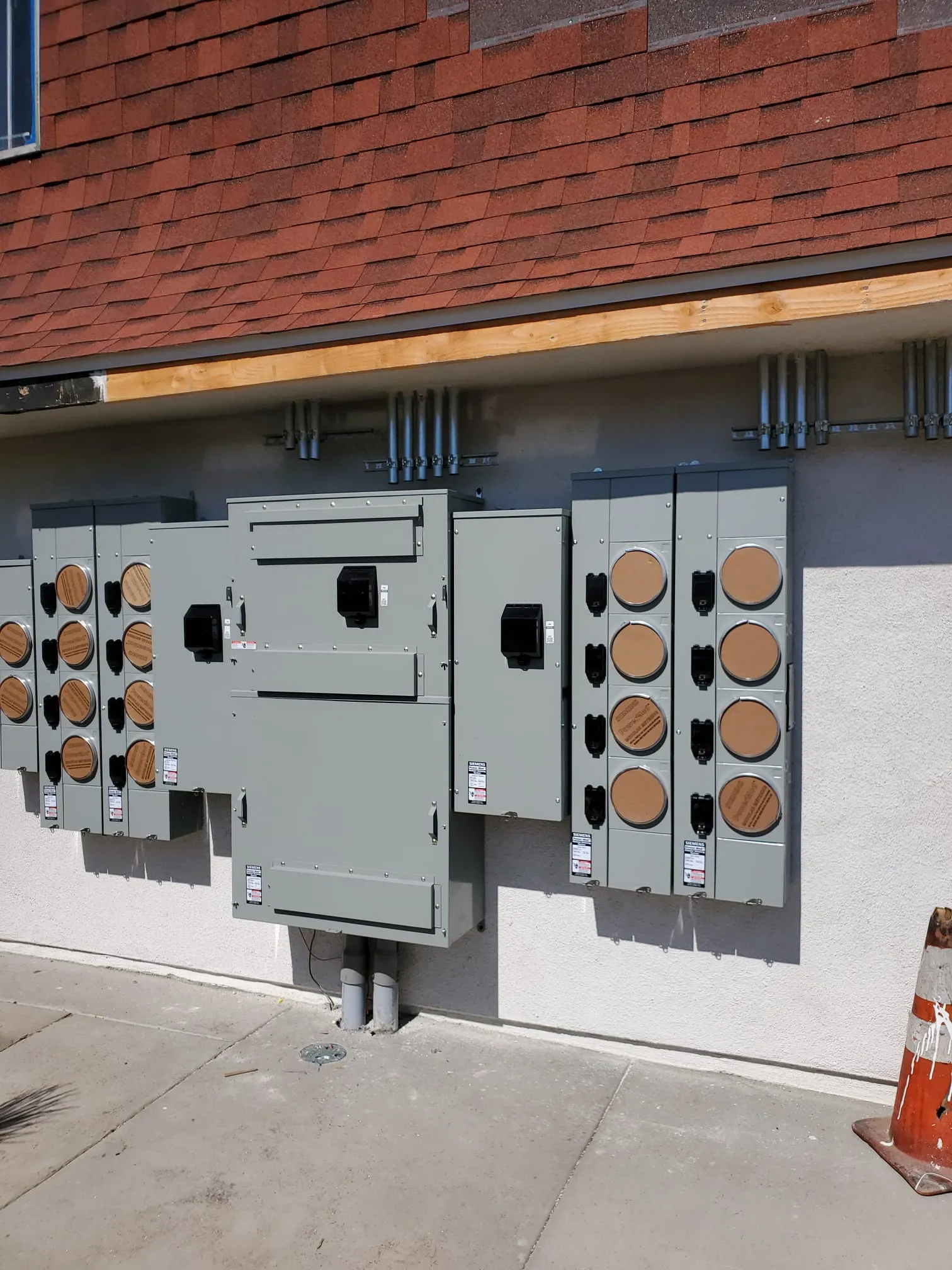
If you’ve never heard of whole-house surge protection, you’re in good company. Most San Diego homeowners haven’t either, until an SDG&E switching event kills three appliances at once and they call us asking what happened.
Surges happen daily. Most are too small to notice. The cumulative damage is what eventually kills your refrigerator compressor or your AC control board. Here’s what whole-house surge protection actually does, what it costs, and when it’s worth it.
How surges actually happen in San Diego
Most homeowners think “surge” means lightning. In San Diego, lightning is rare, fewer than 5 strikes per square kilometer per year, compared to 20+ in Florida. So why bother with surge protection here?
Because most surge damage comes from internal sources, not external ones:
1. SDG&E switching events. When the utility switches load between substations (during outage recovery, peak demand, maintenance), micro-surges propagate through residential lines. We see these almost daily during summer afternoons.
2. Your own appliances. When your central AC compressor cycles off, the inductive load creates a back-EMF surge. Same with your refrigerator compressor, your microwave magnetron shutting down, your washing machine motor stopping. Every cycle puts a small surge on your interior wiring.
3. Neighbor’s appliances on the same transformer. You share a utility transformer with 5 to 15 nearby homes. When their AC kicks on, you see a small voltage transient.
4. Lightning (rare here). Even when lightning hits SDG&E lines miles away, the surge propagates. Less common in SD County but not zero.
Thousands of small surges per year wear out the sensitive electronics in modern appliances (control boards in your AC, dishwasher, washing machine, fridge) long before the mechanical components fail.
How whole-house surge protection works
A whole-house surge protector is installed at your main electrical panel. It’s a relatively small device (about the size of a small cookbook) that sits next to or inside the panel and connects to your main bus.
When voltage spikes above a certain threshold (typically 600V for a residential 120V system), the protector diverts the excess energy to ground through metal-oxide varistors (MOVs) that act as voltage-activated short circuits. The “extra” voltage doesn’t reach your circuits, your outlets, or your appliances.
The protector itself absorbs each surge it diverts. Over years, the MOVs degrade. Quality units have an indicator that shows remaining life: green = fine, yellow = degraded, red = replace.
Cost: $300 to $650 installed
Three components to the install:
| Item | Typical cost |
|---|---|
| Type 2 surge protector (Eaton CHSPT2ULTRA, Square D HEPD80, Siemens FS140) | $150 to $300 |
| Installation labor (90 minutes; includes panel safety check) | $120 to $250 |
| Permit (if required by your city for the install) | $0 to $100 |
| Total installed | $300 to $650 |
If we’re already doing a panel upgrade or an EV charger install at your home, we install the surge protector at the same time and skip most of the labor cost, about $200 to $350 total when bundled.
Type 1 vs Type 2 vs point-of-use: what each does
Type 1: service entrance (utility side)
Installed between the utility meter and your panel. Designed to absorb the largest surges (lightning-class). Required in some commercial and industrial applications. Most San Diego homes don’t need a Type 1. The SDG&E-side protection is generally adequate for the surge magnitudes we see.
Type 2: panel-mounted (load side)
This is what 95% of San Diego homes need. Installed at the main panel. Catches surges that pass the meter and protects everything downstream (every outlet, every hardwired appliance, your HVAC, your kitchen).
We default to a Type 2 with a UL-1449 4th edition listing, 80,000-amp surge current rating minimum, 600V clamping voltage or lower, and an audible/visual end-of-life indicator. Eaton CHSPT2ULTRA and Square D HEPD80 are the two we install most often.
Point-of-use: strip protectors at outlets
These protect what’s plugged into them. Your TV, computer, and home theater equipment all benefit. They do NOT replace whole-house protection because:
- They don’t protect hardwired appliances (AC, fridge, oven, water heater)
- They have lower joule ratings than whole-house units
- They’re degraded by every minor surge, and most are spent within 1 to 3 years and you don’t know
The right setup is whole-house Type 2 as the primary protection, point-of-use strips as the secondary line of defense for sensitive electronics. Belt-and-suspenders.
What it protects against, what it doesn’t
Protected ✓
- AC compressor and outdoor condenser control boards
- Refrigerator and freezer control boards
- Dishwasher / washing machine / dryer electronics
- Microwave inverter circuits
- Smart thermostats, smart switches, smart appliances
- Water heater elements (especially heat-pump models)
- Garage door opener boards
- Pool/spa equipment
- Hardwired LED dimmers and recessed lighting controls
- Whatever’s plugged into surge-protected outlets
Not protected ✗
- A direct lightning strike to your home (extremely rare in SD; needs lightning-rod system, not surge protection)
- Surges originating inside an appliance (faulty equipment)
- Brownouts (low voltage), which need a separate solution like a UPS for critical equipment
- Anything plugged in during a sustained over-voltage event from utility (rare, needs UPS)
When it’s worth it (and when it’s marginal)
High-ROI cases (definitely worth it)
- You have central AC: the compressor control board is one of the most surge-vulnerable + most expensive items to replace ($600 to $1,500).
- Your home has smart appliances: induction range, heat-pump water heater, smart fridge, and all of them have sensitive electronics.
- You have an EV charger: especially the wall connector with a control board.
- Your panel is fed by overhead utility lines (more surge entry points than underground).
- You live in Poway, Rancho Bernardo, Ramona, or Escondido: these areas see more SDG&E switching activity due to grid topology.
- Your home value is $700k+: the appliance and electronics value alone justifies $400 of protection.
Marginal cases (still good but less urgent)
- You have an old panel scheduled for upgrade soon: bundle it with the upgrade for cost efficiency.
- You rent: surge protection benefits the landlord; have the conversation but don’t pay for it yourself.
- Your home is electronics-light: older appliances, no smart home, no EV, so the savings from prevented damage are smaller.
Why we always recommend it during a panel upgrade
When the panel is open for an upgrade, adding a Type 2 surge protector is a $200 marginal cost (instead of $400 to $650 standalone). It’s the single highest-ROI add-on we offer. We covered this in our panel upgrade cost breakdown. Most homeowners say yes when they understand the math.
Why grounding matters first
A surge protector is only as good as the grounding system it relies on. If your home’s grounding rod is corroded, undersized, or missing the water-pipe bond, the surge has nowhere to go and the protector can’t divert it effectively.
We check grounding as part of every surge installation. If your grounding doesn’t meet current code (8-foot copper-clad rod, water-pipe bond within 5 feet of entry, ground bus in the panel), we fix it during the install, usually $80 to $200 added. Without proper grounding, even the best surge protector is partially blind.
This is also one of the things we look at when diagnosing why your breakers keep tripping. Bad grounding can mimic surge symptoms and cause similar damage.
Why Martinez Electric for surge protection
Owner Vicente Martinez has 35+ years at the trade. He knows what major SDG&E events do to unprotected homes in East County and inland SD. We carry Eaton, Square D, and Siemens Type 2 protectors on the truck. Every install includes a grounding check, the unit is sized to your service amperage, and we register the warranty under your name (most manufacturers offer 5 to 10 year warranties on the unit itself plus connected-equipment warranties up to $50,000).
CSLB licensed (#1052901). Standalone install or bundled with any panel work.
Get a quote: Free estimate online or call (619) 249-0956. If you’re in Poway, Rancho Bernardo, Escondido, or San Diego proper, we can usually quote over the phone after a few questions about your panel and amperage.